The May Jobs Report Is Nothing to Celebrate
Last Friday’s nonfarm payrolls release came in at +172k versus consensus estimates of +85k. Financial news outlets described it as a “blockbuster” result. I disagree.
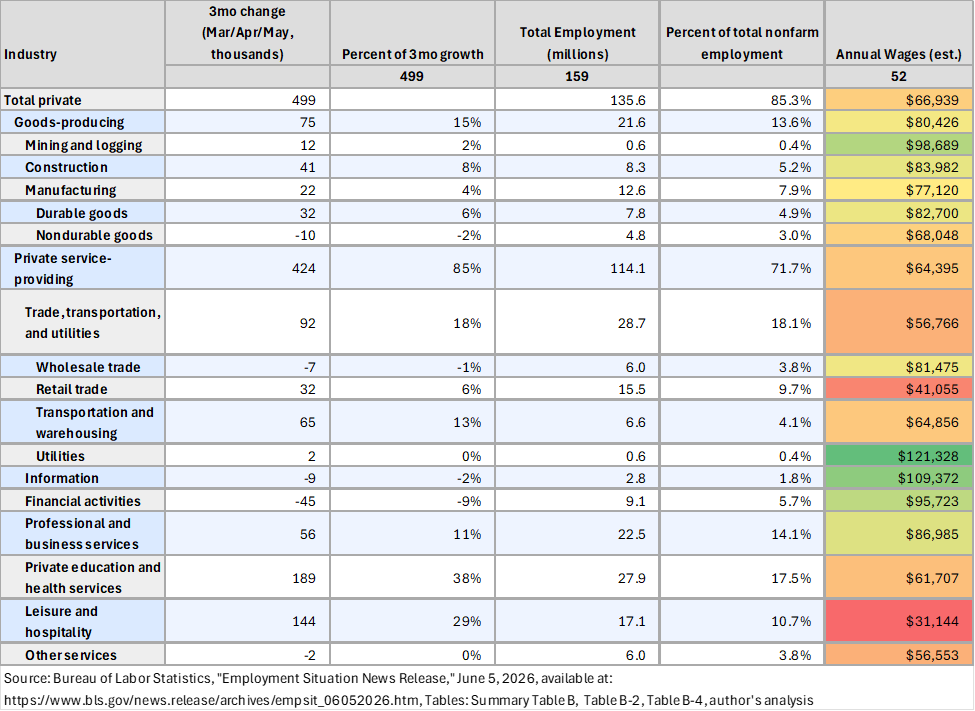
- 86% of the net job creation over the past three months came in sectors paying at or below the national 2025 full-time median of $62,608.
- The two largest sectors that pay well above that—financial services and information—lost -52k jobs in the last three months.
It is true that there are a lot of jobs being created. But a job market creating lots of low-wage jobs while destroying high-wage jobs is not a strong job market. It is a market that is hollowing out.
This table tells me everything I need to know:
Some things that look good on the surface:
- 3mo total nonfarm job growth is +565k, +499k in the private sector. The Dallas Fed estimated that with tightened immigration policy, the breakeven number to keep the job market steady is around +50k per month.
- The unemployment rate is 4.3%. Pretty low.
- The underemployment rate (U-6) hasn’t moved much this year and is currently 8.1%.
What doesn’t look good to me:
- Transportation and Warehousing, Retail Trade, Private Education and Health Services, and Leisure and Hospitality account for +430k of the +499k net jobs created over the past 3 months, or 86%.
- The weighted-average annual salary of these four sectors is $49,465, about $13,000 below the national median of $62,000.
- The national average is about $66,939. The difference between mean and median points to a right-skewed distribution, which is the basic evidence for income inequality. The current mix of job creation—with the bulk at median or below-median sectors—is likely to worsen inequality.
- Higher fuel prices hit these sectors the hardest, as most workers have to travel in person to their jobs.
What about the top end?
- The two big high-paying sectors, Information and Financial Activities, shrunk by -52k over the past three months.
- The other two lucrative sectors, Mining and Logging and Utilities, are tiny and don’t affect aggregates much. Gains in Mining and Logging did offset losses in Information, however.
- Professional and Business Services and Construction, two other above-average pay sectors, are doing fine at net +97k jobs created.
Looking at these numbers, I think about 80% of the jobs being created in the economy are lower-half wage sectors. This does not look like a good job market to me.